4 August 2026
In July this year we spent about a week playing around with a new show that we’ve been developing inspired by the Institut für Sexualwissenschaft or The Institute for Sexual Sciences in English and the man who founded it Magnus Hirschfeld.
This institute, based in the heart of Berlin in the 1919 – 33 was a research centre concerned with developing the understanding and rights of “Sexual Intermediaries”, those whose sexuality, bodies or genders differs from the prevailing norms of the times. The institute became a major centre of one of the word’s earliest organised movement for homosexuality and gender-diverse people. Its guiding light was to develop understanding through scientific, evidence-based research. In doing so Hirschfeld and the Institute hoped to repeal the anti gay law, Paragraph 175, and usher in a new era of acceptance, tolerance and equality for LGBTQ+ people… until the rise of the Nazis when much of the research was lost or destroyed.
“I had heard about the research centre on a Radio 4 documentary which was talking about the Nazi book burnings and that Hirschfeld’s institute was one of the first targets of the student raids. Years of research was ripped from the shelves of the institute and taken to the pyre to be burnt.
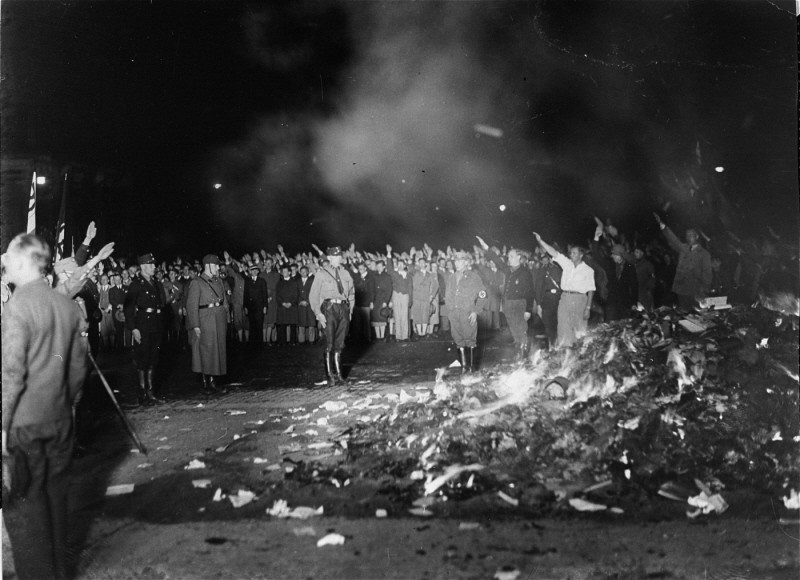
Nazi Book Burning 1933
What really struck me was that the footage of the book burnings, which were so familiar to me actually contained a huge amount of LGBTQ+ research and history going up in flames and that I had never known about it. You can actually see the Nazis parading a bust of Hirschfeld around the fires in some of the images from the night. I was really intrigued that, not only had the research been destroyed, but so too had the knowledge that it had ever even existed in the first place (at least for me).
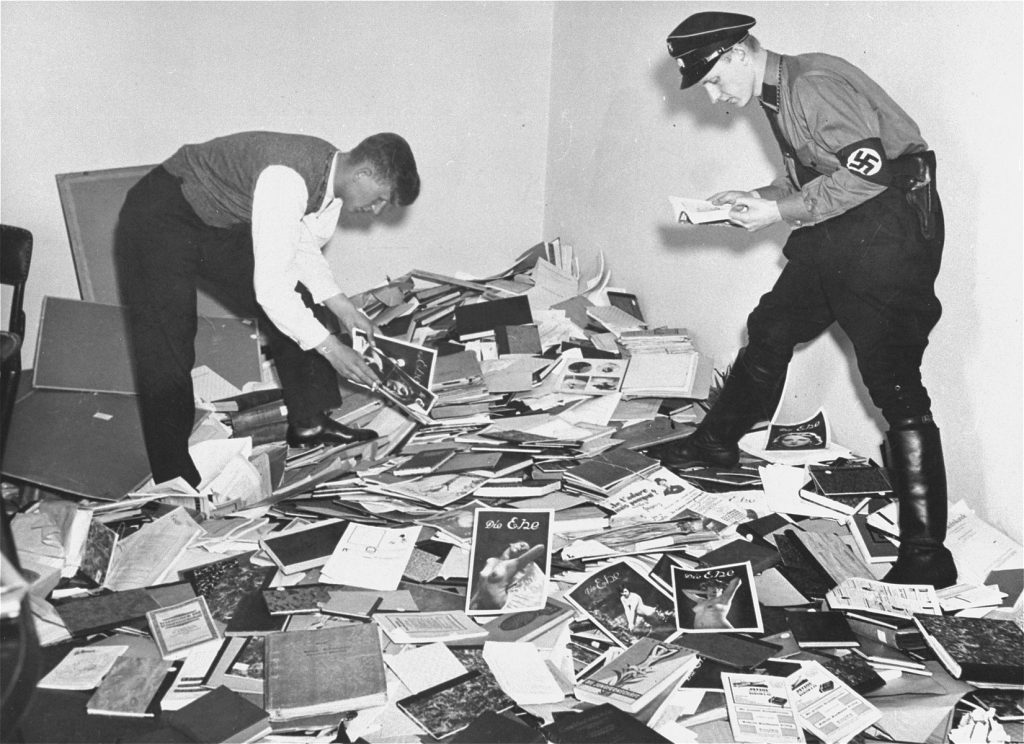
German students and Nazi SA plunder the library of Dr. Magnus Hirschfeld, Director of the Institute for Sexual Research in Berlin. Rare books on the topics of sex and gender were loaded onto trucks and carted away for burning.
Under the Nazi Regime, Paragraph 175 was intensified, expanding to allow arrests of anyone displaying homosexual “behaviour”. When the Nazis were defeated, many LGBTQ+ people were not recognised as victims of the Nazi oppression, as it was argued that the Nazis were simply upholding the legitimate Paragraph 175 from before the Weimar Republic. Therefore many people were not eligible for reparations. In contemporary times gender, sexuality and identity are being argued and weaponised daily which begs the question “Where might we have been today, had this research not been destroyed and lost for so many years?”. It felt like the starting of a new show to investigate.
This period is Research and Development intended for us to be a bit of playground to experiment and find ideas that we could pursue further, no finished show in sight.
We started looking for images, in a sort of open play state, performers would go up on stage, play games and improvise and through the audience we would read the action and allow the associations already in our heads spring context and scenes.
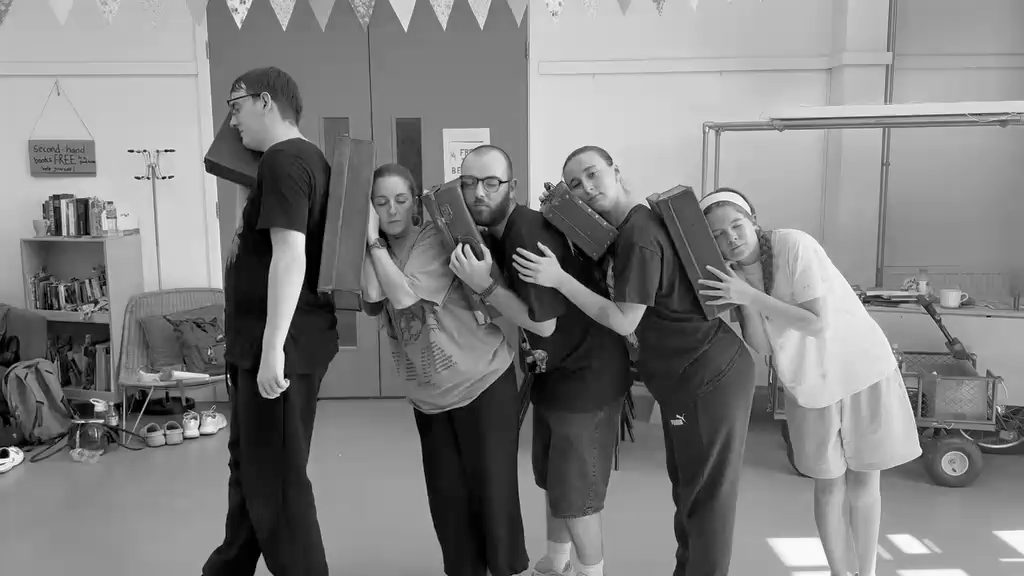
A sleeper train – Ciar Jones, Jes Rowe, Emily Mills, Rose Riddler
For example, a three hander improvisation between Emily Mills, Jordan Taylor and Ciar Jones saw the two boys sheepishly sat around with Emily taking charge to move and reposition them with no real intention or motive. However, for the audience we saw this overbearing mother who was forcing these two young men together, or perhaps instructing them on how to have sex. This became an image that we really liked, the beaming pride of the mother and the awkwardness of the two lovers. As we developed the scenario we revisited this trio at various points, the mother always pushing them together or making them hold hands. The final image we explored was a reversal, the escape that the boys must take, their preparations to flee. The mother entered, sorrowfully packing two suitcases, handing them to the boys. When they instinctively went to hold hands as she had instructed them to do so before, she jumped, ran and slapped their hands apart. It broke our hearts!
At other times we saw a young man, Toby Love, practicing his proposal to his female fiancé, despite knowing deep down that he was gay. We gave Toby a small tin of lip balm to act as a ring box. When the time came to open it, the lid got stuck. Toby rolled around the floor desperately trying to open it but it wouldn’t budge. We fell about laughingly. It was a hilarious and horribly tragic sight to see, the desperation of him attempting to do this one way, then another. Jes Rowe commented “It was as if the whole universe was telling him he can’t do this”.
These random images that were generated sparked memories and associations with some of the text and history we had been researching. We weren’t attempting to recreate particular lives, but imagined fragments that revealed something intriguing and human in them. As the work developed, if we saw connections to real events, we could craft and refine these further. Suddenly, whole story arcs were forming in front of us inspired by play and research.
Suitcases quickly became an object that we revisited again and again. Things in which to hide, to hold to move with. Associations of identity, individuals, whole lives contained within, case studies. We were joined by Glenn Noble to provoke some further ideas and act as a dramaturgical critic. We really liked the suitcases but they felt somewhat shoehorned in for the sake that they looked nice. We dove back into some of the institute and Hirschfeld’s work. And then we found an article on National Geographic, “in the early 1990s a Canadian student found a dumpster filled with suitcases belonging to Magnus Hirschfeld”. These are the moments I adore in devising, when moments rhyme. Two separate entities and intentions coming together to answer one another. Accidental Poetry.
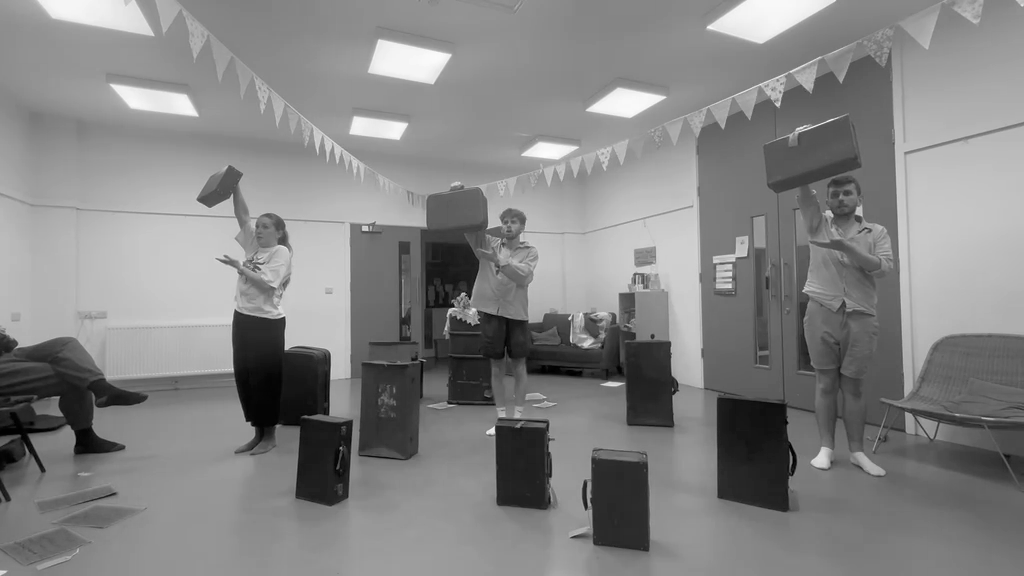
Movement with suitcases Jes Rowe, Toby Love, Connor Alexander
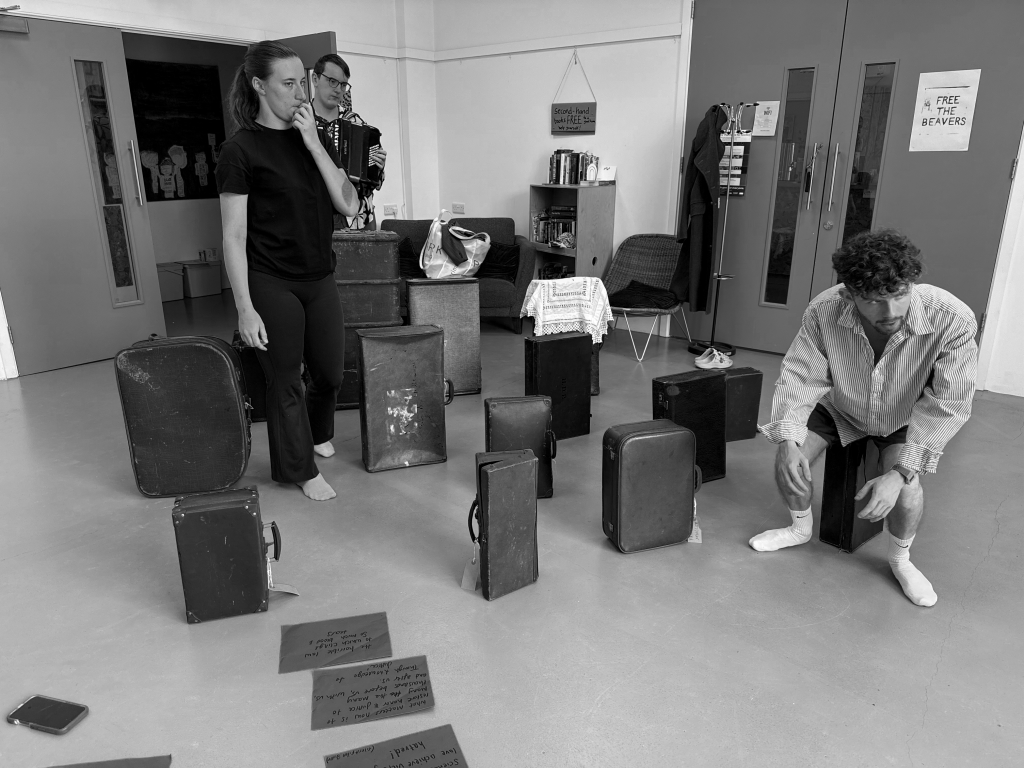
Emily Mills, Ciar Jones, Toby Love
We worked in this fashion to devise for the whole week and then had a spot to showcase the work at The Belgrade Theatre‘s Made in Cov Night as part of their See It First Festival. There was lots of interesting work, chats and feedback to inform the next stages of the work.
I always love devising, creating new things, throwing yourself entirely into the unknown and trusting that you and the people around you will catch you and create something together. The moment when something entirely random happens, but it unlocks an answer to something you didn’t know was there.
This sits at the heart of how we work, trusting the people in the room, pursuing the pleasure of the moment that leads us to bigger questions and allowing play to sit at the heart of it all.
This period has helped to see what the final show might be about. The show Cabaret exists and does a wonderful job at giving us a glimpse into that moment of history. However what we’ve discovered is that the investigation into the scientific process that was applied to LGBTQ+ research, over 100 years ago, intrigues us. I’m interested not in the all singing, all dancing world of Sally Bowles (though I do love it) but instead, for this show, the simple, ordinary people, relationships that the research was built on, and how they were deemed a threat to the Nazis. How has our understanding of sex, gender and identity been blunted by these events? How are our identities constructed if not from a collection of stories and what happens when those stories are lost? How did holding someone’s hand become radical and dangerous?”
We’ll be continuing to develop the show over the coming months, sharing discoveries, questions and fragments from the rehearsal room along the way. Keep an eye on the Journal, or sign up to our newsletter here to follow the work as it develops.